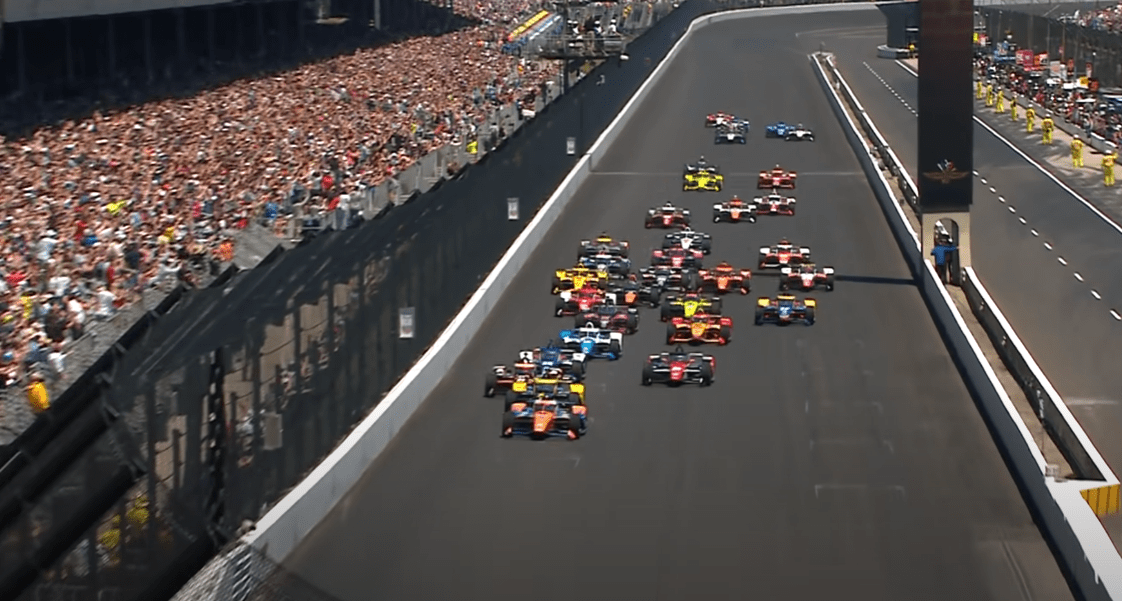
There is a lot of stigma amongst European Formula One and motorsport fans about American motorsports such as IndyCar and NASCAR in the sense that it is boring and cars just drive in circles, however whilst NASCAR is targeted primarily at an American audience (although it in itself can be very exciting), Formula One fans in particular who are abandoning IndyCar because of this perception are missing out on an entertaining form of single seater racing that is even broadcast on the home of F1 in the UK, Sky Sports F1, and a perfect way to cure your F1 withdrawal symptoms outside of Formula One weekends.
The circuits
Firstly, IndyCar does not just race on ovals. In fact the majority of the calendar is made up of traditional race circuits and street races, which include the elevation changes of Road America, the fast, flowing and undulating Barber Motorsport Park, the corkscrew at the famous Laguna Seca, as well as street circuits such as the tricky Belle Isle Street Circuit in Detroit, and the streets of St Petersburg, Florida, which typically produces Baku-esque levels of drama. The calendar also features a few familiar locations to the F1 circus, such as the Indianapolis infield circuit and the streets of Long Beach, and has formerly featured circuits such as Watkins Glen and even the current United States Grand Prix venue Circuit of the Americas.
Oval racing
As I stated there is a stigma about oval racing that it is boring, doesn’t take much skill, and is nothing more than the drivers driving in circles. However that couldn’t be further from the truth. The amount of skill it takes to hustle a single seater with much lower than Monza levels of downforce, around an oval, is something that simply cannot be underestimated, and the thrill of watching cars go wheel to wheel at well over 200 miles per hour is something else entirely. And there is not just one type of oval either. Each oval track featured offers very different challenges to the drivers. The World Wide Technology Raceway, formerly known as Gateway Motorsports Park is a short oval which contains two corners that are basically like a long hairpin on a traditional circuit, Texas Motor Speedway is a superspeedway that contains two heavily banked flat out left handers, which normally allows for some entertaining racing. And of course the famous Indianapolis Motor Speedway is a challenge like no other. More on that later in this post.
The drivers
In terms of the drivers, there is a lot of talent in the series, and there are a lot of familiar faces to Formula One fans in the series. 8 of the drivers competing in races this year have raced in Formula One. The most obvious example this year is Romain Grosjean, who having been dropped from Haas has moved over to IndyCar and is a regular front runner, almost winning at the road course at Indianapolis. The series also includes much fancied underdog Takuma Sato, who has had a long and reasonably successful career in IndyCar, as well as drivers such as Marcus Ericsson, Alexander Rossi, Sebastian Bourdais, Max Chilton and Juan Pablo Montoya (on a part time schedule). Not to mention McLaren currently races in the series as a team. Furthermore, as well as being a place for drivers to race post-F1, the series has proven to be a great alternative for underfunded young drivers that simply don’t have the money to race there. For example Rinus VeeKay was originally on the road to F1 but ran out of money. He moved to the US and made his IndyCar debut in 2020, and has been a regular front runner.
Also the series definitely has world class talent of its own. Most notably defending champion Scott Dixon, who for many is seen as one of the best racing drivers in the world right now, having won the series 6 times, including 2020. Among IndyCar’s crop of home-grown talent includes Will Power, Josef Newgarden, Ryan Hunter-Reay, Tony Kanaan, Colton Herta and many more. The level of talent in IndyCar is definitely close to the level you see in Formula One.
The Road To Indy
As mentioned before, drivers have abandoned Formula One to go onto the IndyCar route due to the fact that it is more affordable. And the reason for this is the Road To Indy programme. On the outside the structure does not look dissimilar to the Road To F1 structure, with Indy Lights the series’ equivalent to Formula 2, Indy Pro 2000 the series equivalent to Formula 3, and the U.S. F2000 the equivalent to the various steps before that. But where IndyCar gets it right is the cost aspect of it. In recent years, the driver budgets for an Indy Lights season have been at around the $900,000 mark. That may seem like a lot but its very minimal in comparison to Formula 2, where driver budgets can be as high as around $3,000,000. Also each step on the ladder has a scholarship system for the winning drivers that pretty much guarantees their promotion to the next step of the ladder. Formula One can really take note of this.
The racing
To Formula One fans wanting a racing fix, IndyCar offers a familiar sight, in the form of highly powered single seater cars racing wheel to wheel. But IndyCar also offers great racing in its own right. Bar engines that are equally matched, the cars are identical and the aerodynamics of the current generation of IndyCar are optimised to allow drivers to follow each other effectively. The series features two types of tyre compound but unlike F1, still features refuelling. What IndyCar is known most for however is its unpredictability. IndyCar features a rule where the pits are closed as soon as a caution period (what they call a safety car period) comes out, and don’t reopen until the field is bunched up. A driver could be out in front dominating the race. But then a caution period could come at the exact wrong time for them, they have to pit and lose track position and the race can be turned upside down in an instant. There have been many occasions where not just drivers with seemingly safe leads have ended up losing a race due to a badly timed caution, but drivers who looked like they had no chance of winning have been thrust into a race winning position.
The Indianapolis 500
Of course I cannot do a post promoting IndyCar without mentioning its centrepiece, the Indianapolis 500. This is self dubbed ‘the greatest spectacle in racing’ and it is perfectly worthy of that title. The event essentially lasts over a fortnight, with testing for the event starting as far as a month before the event. The qualifying session, which is worth points in the championship, takes place a week before the main event, where the grid, as well as who makes the grid, is set by who has the fastest average speed over 4 laps. The drivers go out one by one and is nail-biting to watch trimmed out cars going at speeds well over 200mph around the famous oval with the stakes as high as they are. In a 33 car field, one lift off the throttle can completely ruin a driver’s race, and may even result in a driver not making the field. So the pressure is really on.
And then you get to raceday itself. The Indianapolis 500 typically sees a capacity of around 300,000 fans for the main event. And there are many famous traditions that are held in the build-up, such as the national anthem and the ‘Back Home Again in Indiana’ performance. But arguably the best part of the build-up is the driver introductions, where row by row, the 33 drivers present themselves to the crowd, and are introduced via the loudspeaker. Even watching on TV, it really is an atmosphere like no other.
And then you get to the race itself, and it often is a thrilling 200 laps, that regularly goes down to the wire. The race often features multiple cautions which means multiple times the race turns on its head and the race has seen a shock winner on many occasions. There have been many memorable moments in recent years, such as race leader J.R. Hildebrand crashing at the final corner, allowing the late Dan Wheldon to take the victory, the epic tussle between Ryan Hunter-Reay and Helio Castroneves at the end of the 2014 race, with Ryan taking the win, as well as the former F1 driver Alexander Rossi suddenly being thrust into a race winning position and winning on an economy drive, just having enough to take victory in the 2016 race. And you don’t even need multiple cautions to make this race exciting. The 2021 race only saw 2 caution periods and was entertaining throughout, culminating in an epic battle between Helio Castroneves and Alex Palou as they negotiated traffic, with Helio taking the victory. In every single aspect, the Indianapolis 500 is one of the highlights of the motorsport calendar.
So there you have it. If your a racing fan that is bored on a weekend with no F1, such as this weekend, give IndyCar a shot if its on. Not just is it perfect for curing your F1 withdrawal symptoms, but it makes for great Saturday or Sunday evening entertainment for motorsport fans. It is a truly underrated series that deserves much more worldwide interest than it currently gets.
 RaceWeek