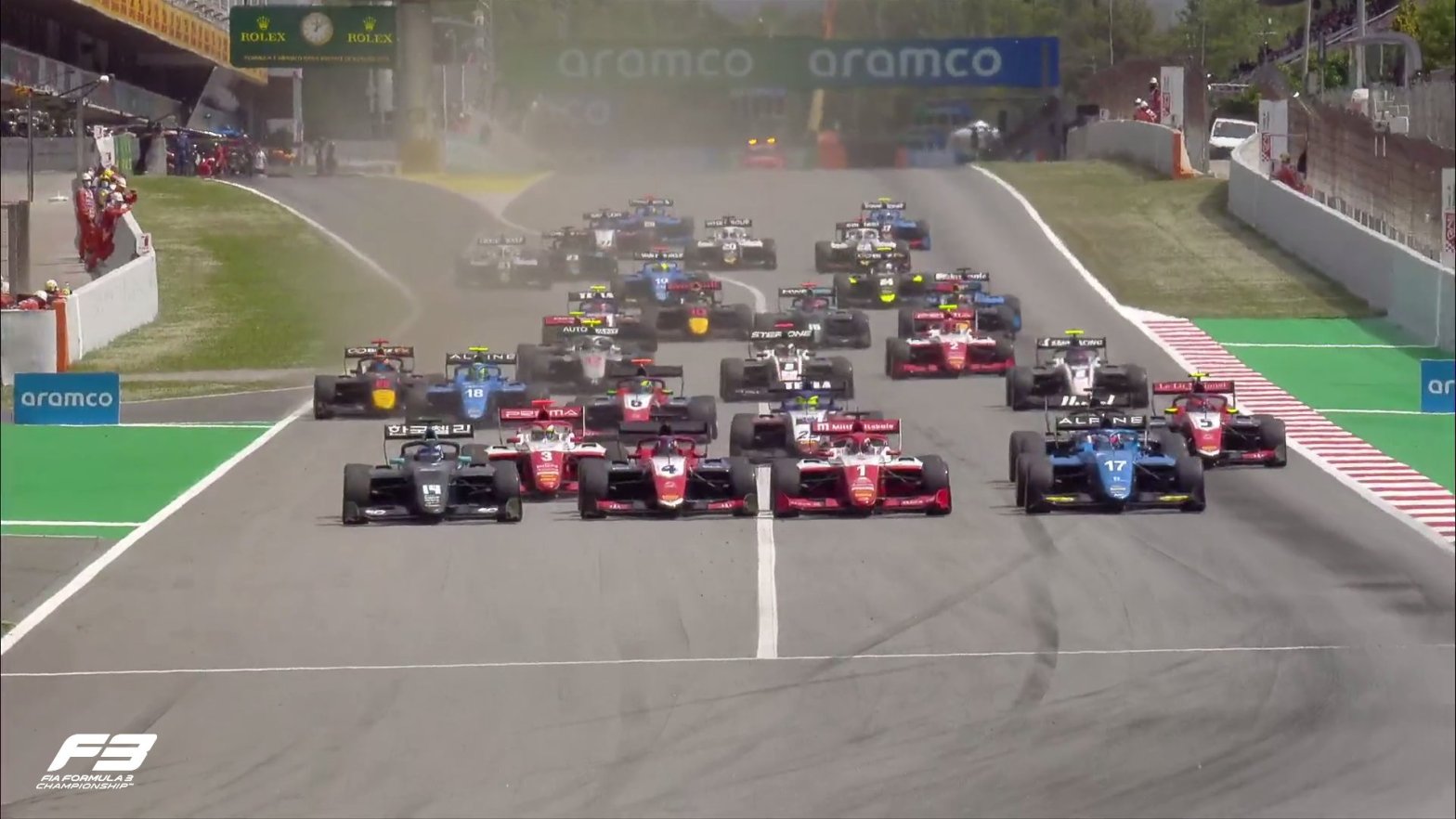
When F2 and F3 announced that they would take cost cutting measures, which involve going to less races but making up for the lost races through having an extra race each weekend, with the first and second races being reverse grids, the first one from the qualifying result and the second one from the result of the first race. Whilst the Sunday race takes the form of the Feature Races that were typically held on Saturdays. Consequently it also meant that the series would no longer run on the same weekends. Whilst I was disappointed with the change, I understood that cost cutting measures had to be taken as we are currently in the biggest economic recession since World War II as a result of the COVID-19 pandemic. And on paper it was not a bad idea. But I feel like they have gone in the wrong direction. This is why.
To start with, there is a perk to this new format which even if a rethink does happen could be exploited in the future. That being that Formula 3 will be racing as the main support race at their events, which will enable their drivers to show themselves off.
But in general I don’t think the weekend format works and this seems to be a prevailing opinion. In principal, it isn’t a bad idea, and it is not like the new format is going to stop avid followers of the junior divisions from watching. But it could deter new fans from watching each of the series.
Firstly the format is perhaps too complicated with too much grid reversing. Firstly the fact that qualifying means pole position for Sunday’s race whilst the Saturday races are reversed. On the Friday qualifying session, viewers get invested in the battle for pole. Then they switch on their TVs on Saturday morning for the first race of the weekend, and the driver they all saw earn pole position is down in tenth or twelfth, whilst a driver they barely saw much of in qualifying is all of a sudden on pole position. That is extremely confusing to a viewer. And for fans of just one of the two series, having 3 races a weekend, then a long break, then 3 races another weekend, the inconsistency makes it difficult for one to follow.
Then we move onto the races themselves. Whilst the first Formula 2 race of the weekend in Bahrain had action, it was mostly just DRS passes, and my concern is that it will be a running trend that the first race of the weekend ends up being a procession as drivers don’t want to risk going for overtakes as they have a race later that day and want to protect their cars, with the consequences of a written off car being 3 races down the drain. And there will be occasions where drivers can win races by qualifying in tenth or twelfth. During the Bahrain weekend, I feel like this new format took the focus off who are the fastest drivers as the constant grid reversing turned it into a lottery and put random drivers up front. And whilst that could make the racing more exciting, I prefer raw drama than manipulated drama, and the action in the first two races felt like the latter. Admittedly these concerns were eased somewhat by the exciting action that we saw in the Formula 3 races at Barcelona.
Compare this to the 2 race format they had before that had worked for over a decade since these two series’ introduction. On Friday, you had practice and then qualifying, which set the grid for the Saturday Feature Races, which was the longer and more valuable race of the weekend, giving those attending races with just a Saturday ticket longer races to enjoy. Then the top 8 on the grid for F2 and the top 10 on the grid for F3 was reversed from the Feature Race result for Sunday’s Sprint races. That was an easy format to understand for people getting into the series and has worked for over a decade. There was nothing broke about this format.
And that is not the only loss as a result of the format change. For fans of both the series, there was something about having F1, F2 and F3 all on the same weekend. It was constant high octane action throughout the three days of action that keeps fans on the edge of their seats throughout the day and encouraged fans attending the races to stay at the track even when the F1 has finished. The Spanish Grand Prix is typically the first race of the season that we have them all on the same weekend and I usually am buzzing for this particular weekend as a result. But that buzz just wass not there. And for those who are a fan of just one of the two series, it is a frustratingly long wait between races. For example fans of F2 that have no interest in F3 have had a long gap between Bahrain and Monaco, and these gaps again could deter spectators. Also with the split calendars, one of the two series was inevitably going to have a lacklustre calendar, and this year that turned out to be Formula 2. It is also frustrating for fans of both series who want to see them in person, one all of a sudden has to fork out the money to go abroad to a race to see whichever series doesn’t race in their country live.
And of course this could have a knock on effect on the drivers. Because of this new format, the drivers are not learning all the circuits and are getting less exposure. For example if this format remained in 2022 and the two series essentially alternated circuits each year, drivers graduating from F3 to F2 for 2022 will not have the chance to learn tracks such as Monaco, Silverstone, Monza etc. And this could have consequences. Matteo Nannini is participating in both F2 and F3 this season, and my concern is other drivers will follow suit and eventually both series will feature many of the same drivers. And if that becomes a trend this would cause costs to skyrocket as drivers would be essentially needing to pay to race in 2 series to stand out. And eventually one of the two series would die out, which would destroy all the efforts the FIA has done to streamline the junior ladder to F1 in recent years.
So going back to the meat of the discussion. As mentioned before they needed to cut costs as a result of the pandemic, and the whole reason this new format is in place is to enable them to have the same amount of races at reduced costs. The question I have is if they reduced the amount of travel, was it really that important to make up for the lost races if it came at the expense of so many things, such as a working weekend format? I personally believe they should’ve gone for quality over quantity. Of course we don’t know how important the individual revenue is to them as effectively a subsidiary of Formula One, but revenue could be lost anyway with this new format for the reasons I described above, as well as driver exposure being hindered as well due to racing on less weekends.
So what I feel like they should’ve done for this year and should do for 2022 if cost saving is still important is simply stick to the European rounds with both series on the same weekends in the format that we have gotten accustomed to over the last decade and a bit. With the originally scheduled European races for 2021 before the pandemic necessitated changes, that would be 9 race weekends of 2 races (8 if F3 doesn’t go to Monaco) resulting in 18 races for F2 and 16 for F3, which is still a solid amount. Meaning that teams can simply transport equipment to each of the races by road and cutting flight costs. And if they really wanted to make up lost races, there’d be no harm in remaining at one of the tracks they raced at and doing a standalone event. I would be very interested to see what the crowd turnout would be if F2 and F3 did a standalone weekend at Silverstone following the race weekend.
Of course they can’t go back on the calendars they published now for 2021, but for 2022 a rethink is needed. But one thing they can do in the meantime to fix some of the issues with the new format for the remainder of 2021 is altering the weekend format with regards to the reverse grids, ensuring the best drivers get maximum exposure, which is what the junior series’ are all about.
It wasn’t a bad idea in principle, but it is not working as well as hoped which seems to be common opinion on social media and a rethink is needed. In the social media era, interest in the junior series has skyrocketed amongst the younger generation, the young drivers battling it out in their development phase to progress up the latter makes for compelling viewing and the structure of a race day with F3-F2-F1 (with Porsche Supercup in the middle, catering to a different demographic of fans) flows nicely and worked well to bring the series in line with the top formula, making it clear there is a true ladder to Formula One.
If it ain’t broke, don’t fix it.
 RaceWeek